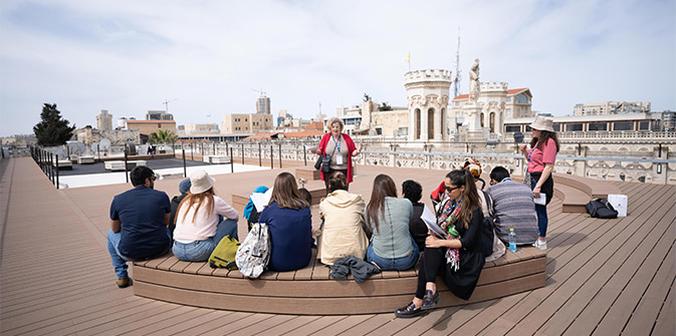
 A tour along seamlines in Jerusalem. “A border is a very individual thing.” (Photo: Simanim Productions)
The premise of the study day was that what we need more than ever in our complex times is leadership that straddles both sides of the argument – to forge connections between diverse leaderships in order to meet the challenges of the day. Thus, the day explored issues relating to leadership on seamlines and in border areas.
Experiential and field-based learning are pillars of the Institute's pedagogical approach, and the study day was given over to tours of Jerusalem in mixed groups, including Haredi women with IDF officers, and non-formal educational leaders with senior academic faculty from the field of teacher education. “Again and again I find that personal encounters and getting out into the field are the key for alleviating otherness and alienation,” said one of the participating fellows, “and there is nothing like Jerusalem.”
The main goals of the day were to encourage interaction between fellows from different programs of the Institute –based on discussing contentious topics and examining social, cultural, and political questions and the role of leadership in addressing these questions – and to bring fellows into contact with the seamlines and border areas in their various fields of influence. Each group explored a particular issue together by touring a challenging area of the city. “Every song, voice, story, and point of view broadens our perspective,” said one of the program fellows. “They create other ways and directions for seeing and understanding the world.”
Participating fellows came from the Mandel Program for Leadership in the Haredi Community (Women), the Mandel IDF Educational Leadership Program, the Mandel Program for Youth Leadership, the Mandel Program for Leadership in Jewish Culture, and the Mandel Program for Academic Leadership in Teacher Education.
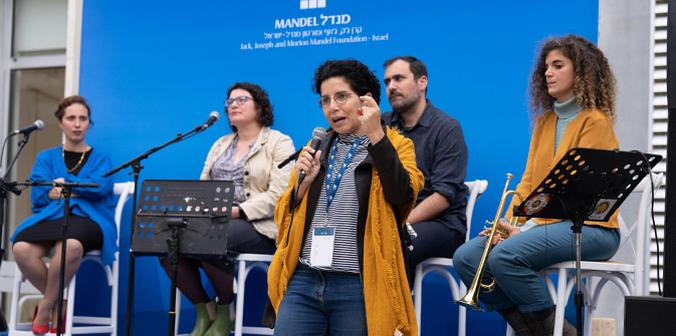 Director of the Mandel Leadership Institute, Yael Hess: “Alleviating otherness and alienation.” (Photo: Simanim Productions)
In recent years, urban planning in Jerusalem has sought to create hybrid nature and leisure spaces to serve local flora and fauna, as well as people. The tour looking at these spaces was led (at an easy jog!) by
Yael Goodman, the founder and director of Run JLM, and took in the Jerusalem bike and running trail as well as parks and urban nature spaces. In between runs, the participants focused on the tension between urban development and natural preservation, and looked at the shaping of the borders of natural areas in the city and at the social, educational, and physical events that stem from crossing and blurring these boundaries. “A border is a very individual thing,” said one of the participants, “and this led me to understand that there are other borders, not necessarily similar to mine, and that everyone sees each border differently.”
Haredim constitute around 30% of the population of Jerusalem and a majority of the neighborhoods in the northwestern neighborhoods of the city. During a tour of Haredi society of Jerusalem, led by the Institute's faculty members
Dr. Noga Bing and
Rabbi Menachem Bombach, the group examined the tension between conservatism and isolationism on the one hand, and openness to the diversity of Israeli society on the other, with a focus on the unique characteristics and challenges of Haredi society and the roles played by its leadership. As one of the participants reported, “I learned about the meaning of self-leadership and its implications for changing things and making them better.”
On another tour, fellows followed the route of the Jerusalem light railway, which traverses holy and secular space, ancient and new, spiritual and political, personal and national, Haredi and secular, Palestinian and Israeli, and West and East. Led by
Dr. Marik Stern, an urban-political geographer who studies cities in conflict, the tour provided a glimpse of the complexity of Jerusalem, as reflected by the intersections between different and parallel Jerusalemite worlds along the track.
Noa Tal-El, a community social worker, introduced the fellows to the seam between normative and non-normative. The city center, despite being “central,” actually houses many of those in the margins, from the Jerusalem Open House, which serves the LGBTQ community, to Independence Park and the Mamilla Pool, which over the years have become gathering places for young people who have not found their place in mainstream society. This tour concluded with a visit to the Hut HaMeshulash (“Triple Thread”) nonprofit, which supports at-risk youth, and showed the fellows how services are provided to young people who have no home and no framework.
Tensions and frictions between different sectors in Jerusalem have also featured in modern Hebrew fiction from its earliest beginnings to today.
Dr. Rachel Korazim, a veteran educator who specializes in Israel studies and Holocaust studies, led a tour focusing on central and canonical texts and which explored different layers of Jerusalemite literature, laid out along ethnic, religious, and nationalist seamlines.
The tour participants moved between establishment sites and geographical and social margins, while reading the poetry of
Ronny Someck,
Erez Bitton,
Joshua Sobol, and
Emile Habibi. Jerusalem may be a city with “a wall at its heart,” but one of the most critical issues concerns a fence. Any exploration of the city must also relate to the Israeli-Palestinian issue, with the border fence at its center. This fence, designed to serve as a buffer between areas controlled by the Palestinian Authority and sovereign Israeli territory, raises more questions than answers: Is the placement of East Jerusalem neighborhoods beyond the fence a statement about the future sovereignty of those areas? What about the residency status of people living in neighborhoods on the other side? And how does the fence affect daily life?
Ezra Korman, an educator and licensed tour guide, led the fellows on a tour exploring these questions, which took in Tel el-Ful and Atarot, continued with an overview of A-Ram, and concluded in Pisgat Ze’ev with an outlook over the Shu’afat refugee camp.
